Windows contribute as much as 60% of the energy lost in buildings. In hot weather, the windows are heated from the outside, radiating thermal energy into the building. When it is cold outside, the windows heat up from the inside, and they radiate heat to the outside environment. This process is called radiative cooling. This means that windows are not effective at keeping the building as warm or cool as it needs to be.
Could it be possible to develop a glass that can turn on or turn off this radiative cooling effect on its own depending on its temperature? The answer is yes.
The Wiedemann-Franz law states that the better the electrical conductivity of the material, the better the thermal conductivity. However, vanadium dioxide material is an exception, which does not obey this law.
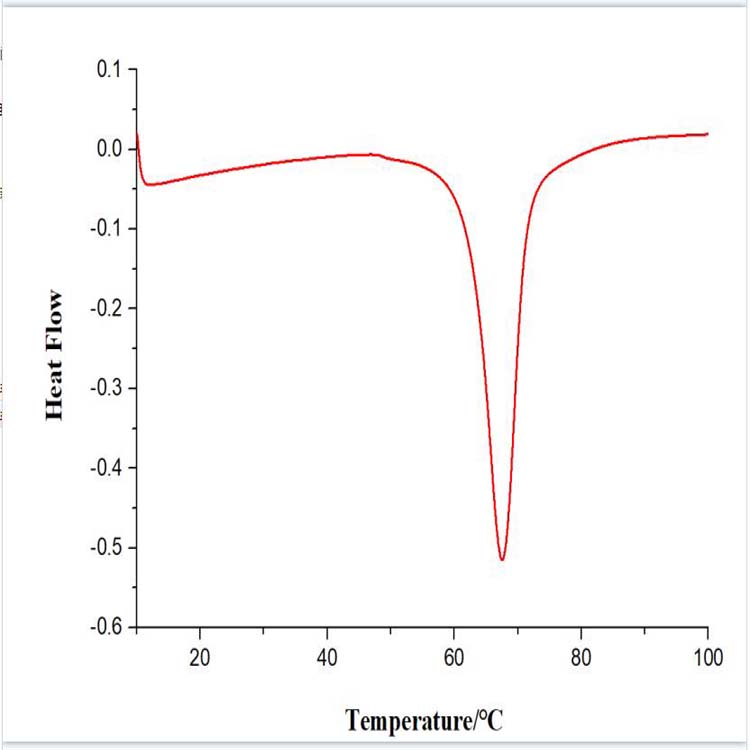
The researchers added a thin layer of vanadium dioxide, a compound that changes from an insulator to a conductor at around 68°C, to one side of the glass. Vanadium dioxide (VO2) is a functional material with typical thermally induced phase transition properties. Its morphology can be converted between an insulator and a metal. It behaves as an insulator at room temperature and as a metal conductor at temperatures above 68°C. This is due to the fact that its atomic structure can be transformed from a room temperature crystal structure to a metallic structure at temperatures above 68°C, and the transition occurs in less than 1 nanosecond, which is an advantage for electronic applications. Related research has led many people to believe that vanadium dioxide may become a revolutionary material for the future electronics industry.
Researchers at a Swiss university increased the phase transition temperature of vanadium dioxide to above 100°C by adding germanium, a rare metal material, to the vanadium dioxide film. They have made a breakthrough in RF applications, using vanadium dioxide and phase-change switching technology to create ultra-compact, tunable frequency filters for the first time. This new type of filter is especially suitable for the frequency range used by space communication systems.
In addition, the physical properties of vanadium dioxide, such as resistivity and infrared transmittance, will change drastically during the transformation process. However, many applications of VO2 require the temperature to be near room temperature, such as: smart windows, infrared detectors, etc., and doping can effectively reduce the phase transition temperature. Doping tungsten element in VO2 film can reduce the phase transition temperature of the film to around room temperature, so tungsten-doped VO2 has broad application prospects.
Hongwu Nano's engineers found that the phase transition temperature of vanadium dioxide can be adjusted by doping, stress, grain size, etc. The doping elements can be tungsten, tantalum, niobium and germanium. Tungsten doping is regarded as the most effective doping method and is widely used to adjust the phase transition temperature. Doping 1% tungsten can reduce the phase transition temperature of vanadium dioxide films by 24 °C.
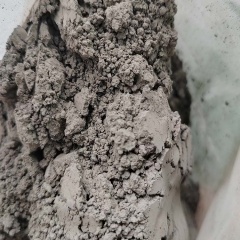
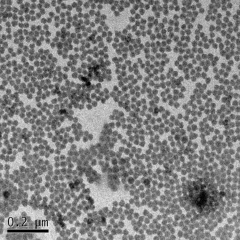
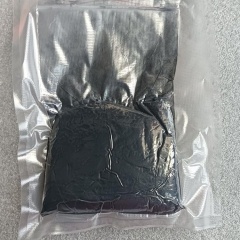
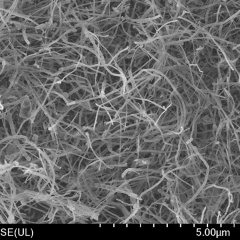
The specifications of pure-phase nano-vanadium dioxide and tungsten-doped vanadium dioxide that our company can supply from stock are as follows:
1. Nano vanadium dioxide powder, undoped, pure phase, phase transition temperature is 68℃
2. Vanadium dioxide doped with 1% tungsten (W1%-VO2), the phase transition temperature is 43℃
3. Vanadium dioxide doped with 1.5% tungsten (W1.5%-VO2), the phase transition temperature is 32℃
4. Vanadium dioxide doped with 2% tungsten (W2%-VO2), the phase transition temperature is 25℃
5. Vanadium dioxide doped with 2% tungsten (W2%-VO2), the phase transition temperature is 20℃
Looking forward to the near future, these smart windows with tungsten-doped vanadium dioxide can be installed all over the world and work year-round.


 English
 français
 Deutsch
 русский
 italiano
 español
 português
 日本語
日本語 한국의
한국의 Türkçe





 8620-87226359,8620-87748917

