Carbon nanotubes
Categories
New products
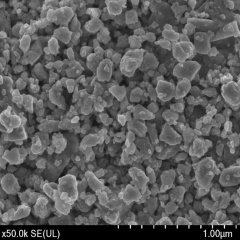
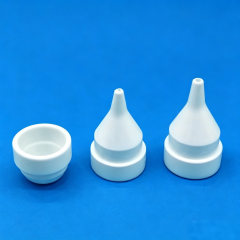
99.99% high purity beta sic nano powders Our 4N nano β-SiC (99.99% purity) is precision-synthesized via CVD, delivering ultra-fine particle size with exceptional sintering activity for high-density ceramic components. It thrives in the most demanding semiconductor environments — from CMP chucks and lithography stages to plasma etch focus rings and chamber liners. Its chemical inertness and minimal metal impurity outgassing maximize chip yield where it matters most. Trusted by leading fabs and equipment makers worldwide. more
Monodisperse spherical Nano SiO₂ aqueous dispersion/colloid This transparent SiO₂ aqueous dispersion is synthesized via patented sol-gel technology, featuring optical excellence visible light transmittance and shelf life >18 months under ambient storage. It is widely used in electronics as low-k dielectric materials, in biomedicine as drug carriers, and in optics for anti-reflection coatings. more
Magnéli Phase Nano Titanium suboxide Ti₄O₇ Powder Magnéli phase Nano titanium suboxide (Ti₄O₇) is an advanced functional material with a unique crystal structure, appearing as a blue-black powder with a precisely controlled particle size of 200–300 nm and a purity of up to 99.9%. As an important member of the titanium oxide family, Ti₄O₇ combines excellent electrical conductivity, chemical stability, and catalytic activity, making it an ideal choice for new energy, environmental protection, and electronics applications. more
Boron Nitride Nanotubes(BNNTs): High Thermal Conductivity Heat Dissipation Fillers BNNTs share the tubular structure of carbon nanotubes but deliver fundamentally different properties: electrical insulation, superior thermal stability (up to 900°C in air), and high thermal conductivity. With a wide bandgap of ~5.5 eV, they offer consistent, predictable performance where CNTs fall short. more
Phase-Smart VO₂ Nanoparticles: Intelligent Thermal Response, Engineered to Order From Thermochromic Color Change material to Intelligent Temperature Control material: The Performance Revolution and Application Blueprint of Vanadium Dioxide and Tungsten-Doped VO2 more
Precision Ceramic 3D Printing Solutions turns impossible structures into reality Precision Ceramic 3D Printing Solutions – Redefining the boundaries of ceramic manufacturing, from dental restorations to aerospace-grade high-temperature components.Precision ceramic 3D printing turns impossible structures into reality. more
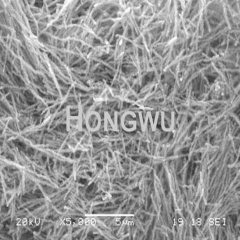
New conductive material nickel nanowires NiNWs Hongwu Nickel nanowires have a wide range of potential applications in electronic materials, catalysis, polymers, magnetic storage ultra-high density recording materials, sensors and self-lubricating materials. more
Transparent Colloidal Ag Antibacterial Nano Silver Colloid Ag (Antibacterial Nano Silver Colloid) has been well known antibacterial, antiviral and antifungal properties are enhanced by small particle size and large surface area. more
Nano silica particles used in epoxy resin, superhydrophobic coating nano silica powder Nano silica particles, 20-30nm, 99.8% purity, widely used in exposy resin and superhydrophobic coating. more
Latest news
Some nanomaterials for Thermochromic Application
Thermochromism refers to the phenomenon where a material undergoes color changes under temperature changes. This change is usually caused by changes in the electronic or molecular structure of the material. Its application principle mainly involves t...
How to achieve the dispersion of carbon nanotubes?
The necessary conditions for uniform dispersion of carbon nanotubes are to break up the dispersion of carbon nanotube agglomerates, short carbon nanotubes, and long carbon nanotubes. The specific dispersion methods include physical methods and chemical methods. The physical dispersion methods include grinding, dispersing, ball milling, and ultrasonics. The chemical dispersion methods include the addition of surfactants, strong acid and alkali washing, and the in situ synthesis. Preparation of carbon nanotube composites.
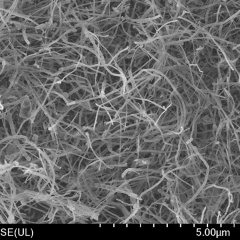
Carbon nanotubes, which are tubular carbon molecules, are sp2-hybridized at each carbon atom on the tube, and are bonded to each other by carbon-carbon sigma bonds to form a hexagonal honeycomb structure as carbon nanotubes. Skeleton. A pair of p-electrons that do not participate in hybridization on each carbon atom form a conjugated π-electron cloud that spans the entire carbon nanotubes. According to the number of layers of the tube, it is divided into single-walled carbon nanotubes and multi-walled carbon nanotubes. The radial direction of the tube is very fine, only in the nanometer scale, and tens of thousands of carbon nanotubes are combined together and only one hair is wide. The name of the carbon nanotubes also comes from this. It can be as long as tens to hundreds of microns in the axial direction.
The difficulty in the dispersion of carbon nanotubes is that carbon nanotubes have the unique properties of large mechanical strength, good flexibility, and high electrical conductivity, in addition to the size effect of nanoparticles in general, making them ideal reinforcements for polymer composites. The chemical, mechanical, electronic, aerospace, aerospace and other fields have a wide range of applications. However, since the carbon nanotubes are apt to be aggregated into bundles or entangled, and compared with other nanoparticles, the surfaces thereof are relatively "inert" and have low dispersion in common organic solvents or polymer materials, which greatly restricts them. widely used. Therefore, the modification of the surface of carbon nanotubes has become one of the research hotspots of polymer/carbon nanotube composites. At present, the research on the surface modification of carbon nanotubes at home and abroad mainly involves the introduction of covalent bonds and non-covalent bonding groups on the surface, such as modification by surface chemical reactions, modification of surfactants, or the use of polymer molecules. Methods of coating and modifying carbon nanotubes have recently been developed. Ultraviolet irradiation, plasma ray modification, and other treatment methods have also been proposed. The use of surface-modified carbon nanotubes in polymer composites can significantly improve the mechanical, electrical, and thermal properties of the material.
Copyright © 2010-2026 Hongwu International Group Ltd All Rights Reserved.
The professional team to service !
8620-87226359,8620-87748917
hwnano@xuzhounano.com
hwnano